Hey All,
Just a quick note on something NEVER to do, and a call for advice on how I should proceed…
I’m fairly experienced with 3D printing. My Taz 4 is the second printer I’ve owned and the third I’ve been solely responsible for operating in an industrial capacity. Recently, I swapped out a spool of SainSmart Dark Brown Wood filament for a spool of IC3D Green ABS filament. As always, I ran about 100mm of the ABS through the nozzle (at the higher temp) to purge it of residue from the previous filament. I printed several ABS objects for a university research project, but I noticed some slight porosity to the sides of the objects; areas where the filament had either delaminated, or failed to flow with sufficient volume.
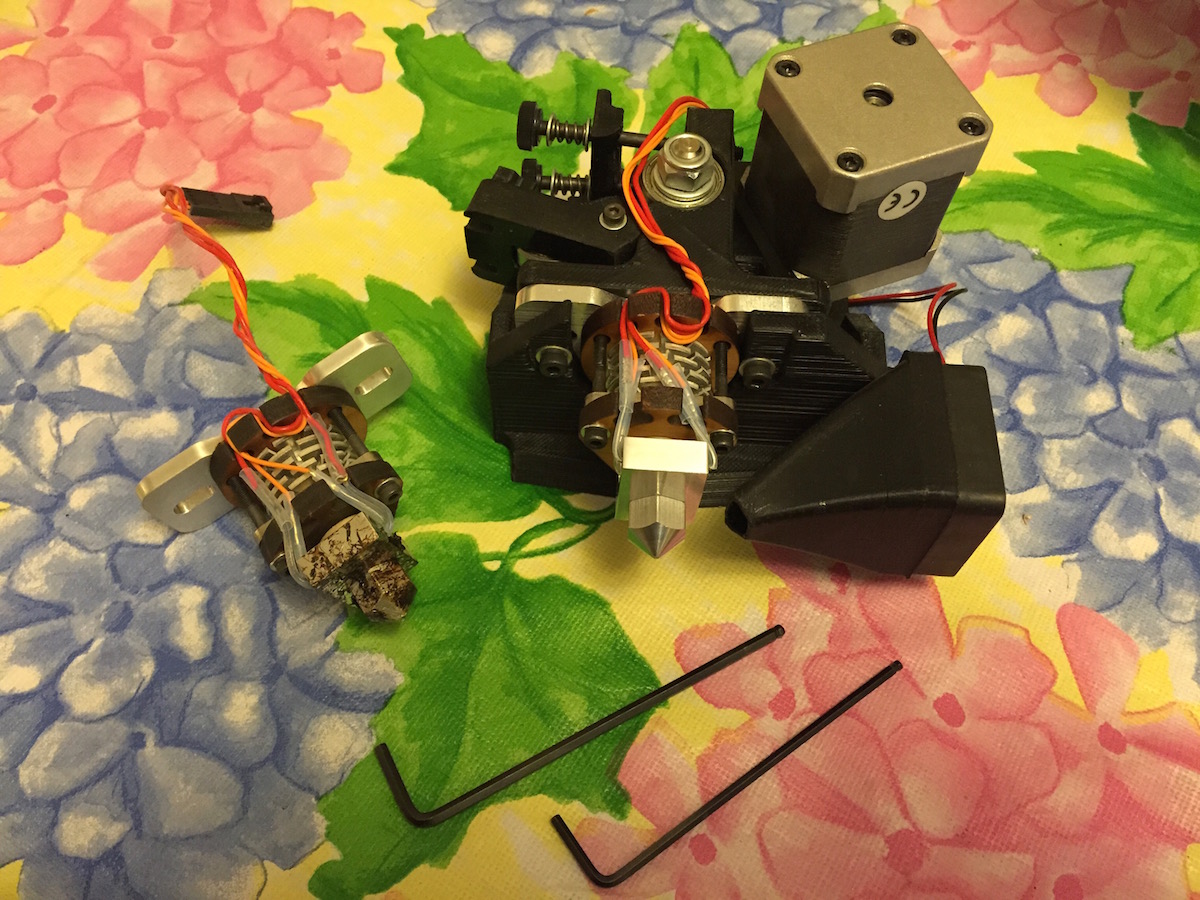
I had observed this problem before (seemingly only with ABS) and I reasoned that the nozzle might be partially clogged. I elevated the Z-axis to a high altitude and began sticking the dental pick up into the nozzle from underneath (at temperature). I had done this before, so I figured it wasn’t a big deal. I was being delicate (or so I thought), and I did manage to draw out a few small scraps of blackened matter from the nozzle, so I was hopeful this had solved the problem.
Sadly, subsequent to this I discovered that the “noodles” being extruded by the nozzle were no longer thin and smooth, but rather fat and ugly. I had inadvertently “bored out” my extruder nozzle.
I stayed up all night tweaking settings in Slic3r and running test prints, trying desperately to get ANYTHING to print properly. I fiddled with the extruder nozzle diameter and extrusion width settings. I fiddled with the extrusion multiplier setting (outputs more or less material while printing). I tried adjusting the Z-gap and varying the amount of acetone/ABS coating on the platform. Of course I tried different extrusion and bed temperatures. Nothing worked. Evidently, I bitched that poor machine up royally, and it is now dead in the water. Having an extruder nozzle with the diameter of a firehose, it seems, is simply not a viable way to 3D print.
I speculate that my previous work with the dental pick might have done some damage, but this was the last straw that killed the printer. I believe that although I was being gentle, the fact that the nozzle was at high temperature made the metal (I believe they are aluminum?) more malleable and prone to damage in this way.
I strongly suggest never to insert the dental pick into the extruder nozzle from the underside. In retrospect, it was a very stupid thing to do, and it’s a mistake that’s going to cost me $100 and at least a week of downtime.
I do have a few questions for all of you; most of whom I assume are more knowledgeable than I am:
-
What diameter extruder nozzle would you recommend to replace it? I believe the factory one was 0.35mm. I don’t know what pros/cons exist for choosing a larger vs. smaller diameter. I’m guessing smaller diameter nozzles allow greater precision/higher detail, while larger diameter nozzles allow faster printing and perhaps less frequent clogs?
-
Any theories on what might have caused the ABS porosity problem? I stupidly gave the printed parts to my buddy at the uni without first taking any pictures of them, but I may be able to find previous examples to post pictures of.
-
Would a stainless steel nozzle be less prone to such damage, and if so, are there any that are compatible with the Taz 4?
-
Any sage advice on cleaning/unclogging a nozzle that’s not likely to damage it?
Please don’t feel obligated to answer all of my questions; any helpful hints would be well appreciated. I hope this horror story saves somebody the pain of doing what I did (not to imply that there’s anyone quite as dumb as I am on here!) 
Cheers,
~ Peter DeSimone
Chief Imagination Officer, Lyratron